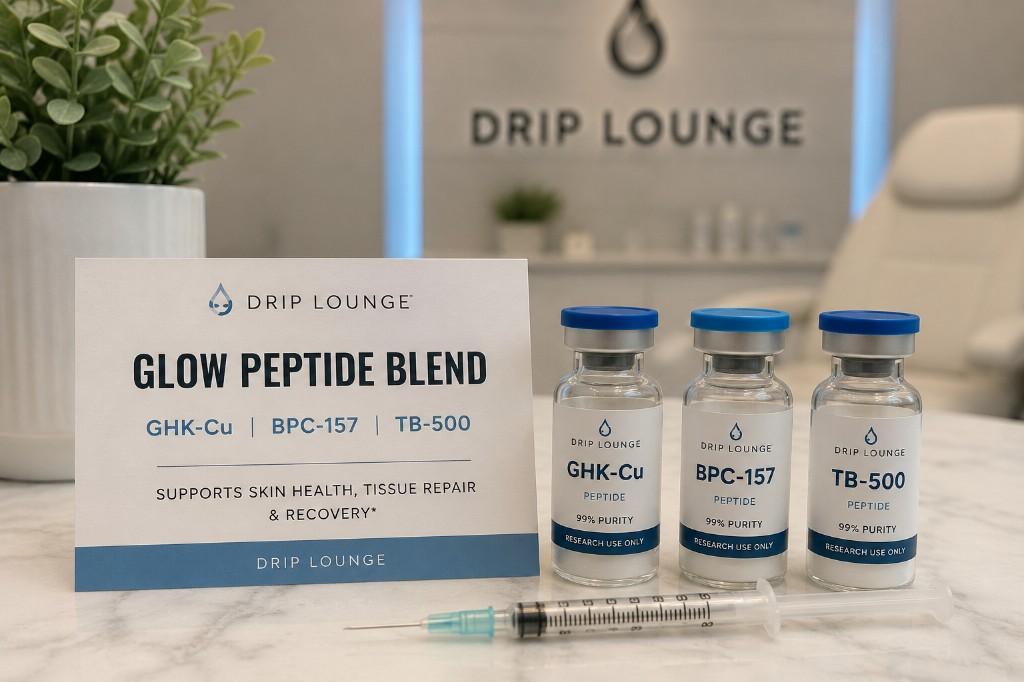
GLOW Peptide Blend is not a single peptide. The name generally refers to a combination of GHK-Cu, BPC-157, and TB-500 or a related thymosin beta-4 fragment. These compounds are discussed for skin quality, tissue signaling, and recovery, but the exact three-peptide injectable combination has not been established as safe or effective in controlled human clinical trials. Each component also has a very different evidence and safety profile.
At Drip Lounge, the goal is to separate what peptide science actually shows from what peptide marketing promises. If you are specifically researching the formulation, you can review the GLOW Peptide Blend page, or explore the broader Drip Lounge peptide wellness collection.
The most important distinction is this: GHK-Cu has some human research involving topical skin use, while injectable GHK-Cu has far less human safety information. BPC-157 remains largely preclinical with very limited human evidence, and FDA reports that it has not identified human exposure data for the TB-500 fragment sufficient to characterize its safety.
This guide explains what each ingredient is, what researchers have actually studied, what remains unknown about combining them, and why sourcing and medical oversight matter.
Written by: Drip Lounge Editorial Team
Medically reviewed by: Dr. Megan Nickerson, DNP (Doctor of Nursing Practice) · Last medically reviewed: August 11, 2026
Last updated: August 11, 2026
Medical disclaimer: This article is for education only and does not recommend GLOW Peptide Blend, GHK-Cu injections, BPC-157, TB-500, a specific dose, or a treatment protocol. These compounds and routes have different regulatory and evidence profiles. Treatment decisions should be reviewed with a qualified healthcare professional.
GLOW Peptide Blend at a Glance
| Question | Evidence-Based Answer |
|---|---|
| What is GLOW Peptide Blend? | A marketing name generally used for a combination of GHK-Cu, BPC-157 and TB-500 or a related thymosin beta-4 fragment |
| Is GLOW one peptide? | No. It is a multi-peptide formulation |
| Why is it marketed? | Common themes include skin appearance, collagen, recovery and tissue support |
| Is the injectable blend FDA-approved? | No |
| Has the exact three-peptide blend been established in a controlled human trial? | No published controlled human trial of the exact GHK-Cu + BPC-157 + TB-500 combination has been identified |
| Which ingredient has the strongest human skin evidence? | GHK-Cu has some topical human data, though results are mixed |
| Does topical GHK-Cu evidence prove injectable GLOW works? | No |
| Are BPC-157 and TB-500 well established in humans? | No. Human evidence is limited, especially for TB-500 |
| Does "research use only" establish medical quality? | No |
FDA currently identifies injectable GHK-Cu, BPC-157, and TB-500-related compounded products as substances with important safety-data or peptide-quality concerns.
What Does "GLOW Peptide" Actually Combine?
The name GLOW is branding rather than the name of one naturally occurring peptide. The concept combines compounds that are individually associated with different areas of peptide research.
That distinction is important for both SEO and medical accuracy. A page saying simply "GLOW stimulates collagen and accelerates healing" collapses three separate compounds—and three very different evidence bases—into one unsupported claim.
GHK-Cu: The Copper Peptide
GHK-Cu is a copper-binding tripeptide composed of glycine, histidine, and lysine bound to copper.
GHK naturally occurs in the human body, and the copper complex has been studied for its involvement in tissue remodeling and wound-related biological pathways. Laboratory research has examined effects involving fibroblasts, extracellular matrix signaling, collagen expression, and tissue repair.
For cosmetic purposes, however, the route of administration matters enormously.
Topical GHK-Cu has at least some human data. In a small randomized study of 13 patients after CO₂ laser resurfacing, topical copper-tripeptide skincare did not significantly improve objective wrinkle or erythema outcomes compared with the control regimen, although patient-reported skin-quality satisfaction was higher.
That is a useful example of how evidence should be interpreted: there is human topical research, but it is not proof of dramatic cosmetic regeneration—and it does not establish the safety or benefit of injecting GHK-Cu systemically.
FDA currently states that injectable compounded GHK-Cu may pose immunogenicity risk related to aggregation and peptide impurities and that human safety data for injectable use are limited.
BPC-157
BPC-157, or Body Protection Compound-157, is a synthetic 15-amino-acid peptide widely discussed in recovery communities.
Most of its evidence comes from animal and laboratory research involving tissue injury, inflammation, vascular signaling, and gastrointestinal models. Human evidence remains substantially thinner.
A 2025 human pilot study evaluated intravenous BPC-157 in just two participants. Neither reported adverse effects and investigators observed no major changes in the selected biomarkers during the very short study. But two people cannot establish population-level safety, identify rare reactions, establish long-term effects, or validate other routes of administration.
A randomized Phase 2 study of subcutaneous BPC-157 for acute hamstring injury began recruiting in 2026, illustrating that controlled human research is only now beginning to develop more meaningfully. Results are not yet available.
FDA's current position remains cautious: the agency says human safety information is limited and identifies potential concerns around immunogenicity, peptide-related impurities, and active-ingredient characterization.
For more context, read How Long Does BPC-157 Take to Work?.
TB-500 and Thymosin Beta-4
TB-500 is commonly described online as a fragment related to thymosin beta-4, a naturally occurring 43-amino-acid peptide involved in cellular processes such as actin regulation and tissue-response signaling.
This distinction is particularly important because human studies of full-length thymosin beta-4 are not automatically studies of TB-500.
Full-length thymosin beta-4 has been tested in humans. For example, randomized studies have examined intravenous thymosin beta-4 in healthy volunteers and topical formulations in wound and ocular settings. A Phase 1 IV study reported mostly mild-to-moderate adverse events and no dose-limiting toxicity over its relatively short observation period.
But FDA specifically distinguishes the fragment marketed as TB-500. The agency states that it has not identified human exposure data for drug products containing the TB-500 thymosin beta-4 fragment sufficient to characterize safety and flags potential concerns involving aggregation, peptide impurities, and immunogenicity.
So:
Evidence on full-length thymosin beta-4 should not be presented as proof that injectable TB-500 is safe or effective.
What Has Been Studied for Each GLOW Ingredient?
The evidence becomes much clearer when the three compounds are separated.
| Ingredient | Evidence Is Strongest In | Evidence Is Weakest In |
|---|---|---|
| GHK-Cu | Laboratory tissue research and limited topical human skin research | Systemic injectable cosmetic use |
| BPC-157 | Animal and laboratory injury/recovery models | Large controlled human efficacy and long-term safety trials |
| TB-500 | Mechanistic research and related full-length thymosin beta-4 studies | TB-500-specific controlled human safety and efficacy data |
| GLOW combination | Theoretical combination rationale | Controlled human trials of the exact blend |
This is why simply saying that "all three peptides have research" is misleading.
Research on three ingredients separately does not establish the safety or effectiveness of combining them in one vial.
What Has Not Been Studied: The GLOW Blend Itself
This is the biggest evidence gap.
No published controlled human study or registered clinical trial testing the exact GHK-Cu + BPC-157 + TB-500 GLOW combination as a standardized injectable formulation has been identified.
That means we do not have validated human information establishing the blend's combined pharmacokinetics, interaction profile, long-term immune effects, optimal ratio, cumulative copper exposure, systemic safety, or cosmetic effectiveness.
Even research involving BPC-157 plus related thymosin-beta compounds is extremely limited. One small retrospective knee-pain report included only four patients who received a BPC-157 plus TB4 combination, which is nowhere near sufficient to establish the safety or effectiveness of the GLOW formulation.
The appropriate conclusion is:
Mechanisms that look complementary on paper do not establish synergy, safety, or clinical benefit in people.
GLOW Peptide Benefits: What Marketing Says vs. What Research Supports
Skin Radiance and Collagen
GLOW is often marketed around words like "radiance," "collagen," "rejuvenation," and "skin regeneration."
There is a legitimate biological reason GHK-Cu appears in that conversation. GHK-Cu has been researched in fibroblast biology and tissue-remodeling pathways, and topical copper-tripeptide products have been evaluated in human skin.
But three conclusions do not follow automatically:
- injecting GHK-Cu is equivalent to applying it topically;
- combining it with BPC-157 and TB-500 improves its effects;
- or GLOW injections have been clinically proven to make skin more radiant.
They have not.
For readers mainly interested in cosmetic peptide science, our GLOW Peptide Blend page should be read alongside this evidence and safety context.
Tissue Repair and Recovery
BPC-157 and TB-500 are heavily promoted for tendon, ligament, muscle, and soft-tissue recovery.
A 2026 sports-medicine review described the rapid growth of unapproved recovery-peptide use while emphasizing that many of these compounds lack the regulatory evidence base of approved medications.
For BPC-157 specifically, a controlled human hamstring study is now underway, but results are not yet available.
For TB-500, the human evidence gap is even greater according to FDA's review.
If recovery is your primary interest, see Healing Peptides and Tissue Repair, Best Peptides for Tendon and Ligament Healing, and Why Athletes Are Exploring Peptide Therapy for Recovery.
"Whole-Body Regeneration"
Terms such as "full-body regeneration," "repair from within," and "systemic rejuvenation" are marketing concepts, not validated outcomes for the GLOW blend.
No controlled human clinical trial currently establishes that an injectable GHK-Cu + BPC-157 + TB-500 combination regenerates the body, reverses aging, or treats systemic injury.
That does not mean the biology is uninteresting.
It means interesting mechanisms and established clinical outcomes are different levels of evidence.
Is GLOW Peptide Blend Safe?
The most accurate answer is:
The safety profile of the exact GLOW combination has not been established.
That is different from saying it is proven unsafe.
Each ingredient introduces a separate uncertainty:
- FDA says injectable GHK-Cu has limited human safety data and potential immunogenicity concerns.
- FDA says BPC-157 has limited human safety information and peptide-quality concerns.
- For TB-500, FDA says it has not identified human exposure data sufficient to understand its safety risks.
Because the three are then combined, additional questions arise about interactions and cumulative exposure.