For many women, the years between their late thirties and mid-fifties bring a quiet but persistent shift. Energy that used to come easily starts to fade. Body composition changes despite consistent effort. Sleep becomes lighter, recovery takes longer, and the reflection in the mirror begins to feel unfamiliar. These experiences are not imagined; they are the physiological reality of perimenopause and menopause, and they drive a growing number of women to explore what options exist beyond conventional care.
One conversation that is appearing more frequently in midlife wellness circles involves sermorelin, a peptide that works by stimulating the body's own growth hormone signaling rather than directly supplying synthetic hormones. At NY Drip Lounge, clients across the region can explore provider-guided peptide wellness through our Newburgh lounge and through mobile IV therapy in New York City—including mobile IV therapy in NYC, Brooklyn, Queens, Westchester, the Bronx, and communities throughout the Hudson Valley—making it easier than ever to learn whether options like sermorelin may align with your midlife vitality, recovery, and wellness goals.
Disclaimer: This article is for educational purposes only and does not constitute medical advice. Sermorelin requires an individualized evaluation and prescription by a licensed healthcare provider. Results vary. Research specifically in women remains limited.
Quick Answer: What Is Sermorelin for Women?
Sermorelin is a growth hormone-releasing hormone (GHRH) analog—a synthetic peptide that signals the pituitary gland to produce more of the body's own human growth hormone (HGH), rather than delivering HGH directly. This distinction matters. Because it works through the body's natural feedback systems, the pituitary retains control over how much growth hormone is actually released, which many providers consider a more measured approach than direct HGH administration.
In midlife wellness conversations, sermorelin is often discussed in the context of body composition, energy, recovery, skin health, and vitality—the same areas where many women begin to notice decline as hormonal shifts unfold. Research specifically on sermorelin's benefits in women is still limited, and provider guidance remains essential. But interest is growing, and for good reason.
Why Women Explore Sermorelin in Midlife
Perimenopause and menopause do not affect just one system; they create a cascade of changes that touch nearly every aspect of daily life. Women come to midlife wellness conversations with a wide range of concerns:
- Changing body composition — weight that accumulates around the midsection despite no change in diet or exercise
- Stalled metabolism — the sense that the body simply does not respond the way it once did
- Persistent fatigue — not occasional tiredness but a baseline energy level that feels lower than it should
- Reduced strength and slower recovery — workouts that used to feel manageable now leave women feeling depleted for days
- Lower libido — a shift that can affect confidence and relationships in ways that are difficult to discuss
- Skin and collagen changes — loss of firmness and texture that seems to accelerate after menopause
- Mood and cognitive shifts — brain fog, difficulty concentrating, and emotional variability that can disrupt professional and personal life
Some of these women have already explored conventional hormone replacement therapy. Others are looking for something different: a non-testosterone, non-direct-estrogen conversation about supporting the body's own systems. Sermorelin enters that conversation as an option worth understanding.
Read more: Where to Buy Wolverine Stack Peptides: What to Know Before Choosing a Provider
How Sermorelin Works
Sermorelin mimics naturally occurring GHRH, the hormone the hypothalamus uses to tell the pituitary to release HGH. As women age, GHRH signaling declines, and with it, the pituitary's production of growth hormone. Sermorelin is designed to restore some of that signaling.
Because it stimulates natural production rather than bypassing the pituitary entirely, the body's own regulatory mechanisms remain in place. The pituitary can still respond to feedback signals and modulate output accordingly.
Sermorelin is currently prescribed off-label as a daily injectable in older adults. It is not a DEA-controlled substance, which distinguishes it from testosterone therapy in terms of prescribing and patient access. Dosing is individualized and determined by a licensed provider based on health history, goals, and monitoring.
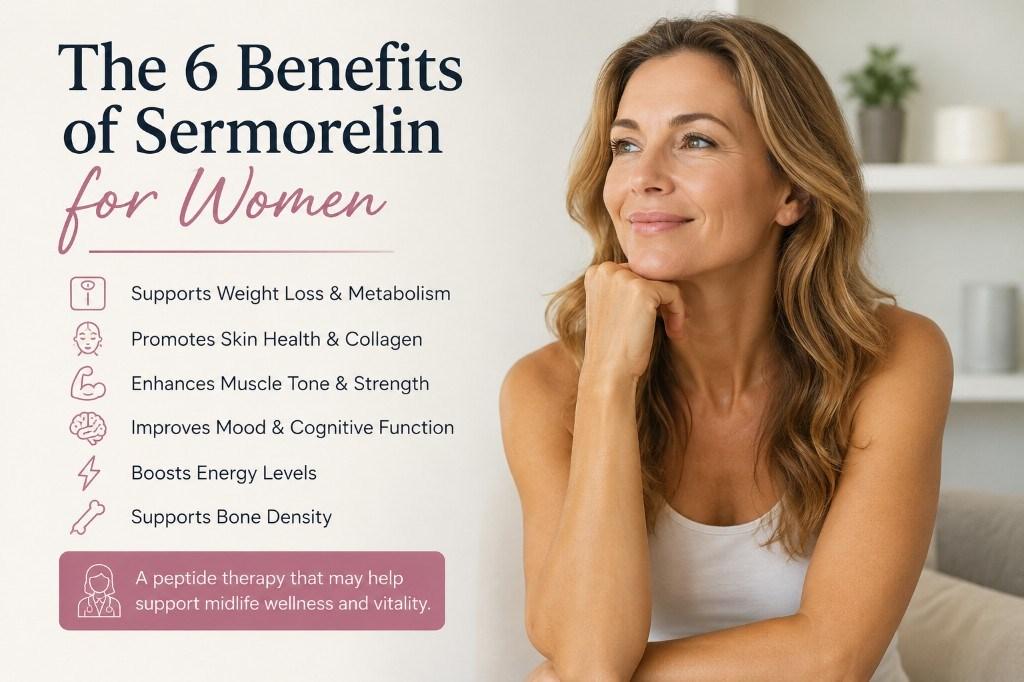
6 Potential Benefits of Sermorelin for Women
1. May Support Weight Loss and Metabolism
Body composition is one of the most commonly cited reasons women explore sermorelin. Growth hormone plays a role in metabolic function, including how efficiently the body processes sugar and how it partitions energy between fat storage and lean tissue. When growth hormone signaling declines in midlife, some of that metabolic flexibility goes with it.
Sermorelin is discussed in this context as something that may support more efficient metabolic function and help preserve or develop lean muscle mass—particularly when combined with consistent resistance exercise and a supportive nutritional approach. It is important to be clear: the evidence here is still limited, much of it is drawn from HGH biology rather than direct sermorelin studies, and not all research has been conducted in women specifically. The framing should always be "may support," not a guarantee of weight loss results.
2. May Support Skin Health and Healthy Aging
Growth hormone plays a recognized role in the synthesis of collagen and elastin—two structural proteins that give skin its firmness and elasticity. As HGH production declines with age, skin changes including reduced firmness, increased texture irregularities, and diminished resilience are commonly observed.
Sermorelin's potential to stimulate growth hormone signaling has led to interest in whether it may support collagen and elastin expression, and whether women using it consistently over time notice improvements in skin quality. This area of interest is legitimate, but claims should remain measured. Sermorelin is not a cosmetic treatment, and outcomes vary. The more accurate framing is that it may support the hormonal environment in which healthy skin function is possible.
3. May Support Muscle Tone and Strength
Sarcopenia—the age-related loss of muscle mass and strength—accelerates for many women after menopause. Growth hormone is involved in the signaling pathways that support lean tissue development and preservation, which is why midlife body-composition concerns often involve a discussion of HGH-related factors.
Sermorelin may support muscle tone and lean mass preservation, particularly in women who are also engaging in regular strength training. The operative word is "may"—research on sermorelin's specific effects on muscle in women is mixed and still evolving. This is not a performance-enhancement conversation; it is a healthy-aging conversation about maintaining functional strength and body composition over time.
Read more: Peptide That Makes You Look Tan? What Science Says About Tanning Peptides
4. May Support Mood and Cognitive Function
Brain fog. Difficulty concentrating. Emotional variability that feels disproportionate to circumstances. These are symptoms many women in perimenopause and menopause describe, and they are among the most disruptive to daily life.
Growth hormone-releasing hormones like sermorelin have been studied in the context of GABA function and central nervous system signaling, with some research suggesting possible ties between GHRH activity, mood regulation, and cognitive function. This is an area of genuine scientific interest—but it is also an area where overstatement would be easy and inappropriate. Sermorelin is not a mental health treatment. The language here must be careful: it may support the neurological environment associated with mood stability and mental clarity, but it should not be positioned as a treatment for depression, anxiety, or cognitive decline.
5. May Support Energy Levels
Energy is perhaps the most universally relatable concern women bring to midlife wellness conversations. The fatigue that accompanies hormonal transition is not simply about sleep—it reflects changes in metabolism, cellular energy production, body composition, and hormonal signaling all converging at once.
Sermorelin's potential to support metabolism, lean tissue, and growth hormone signaling makes energy one of the areas most commonly discussed in the context of this peptide. Women who use it under provider guidance often report energy as one of the first areas where they notice a subjective shift—though individual results vary significantly, and the timeline for noticing any benefit is measured in months, not days.
6. May Support Bone Density
This benefit is especially relevant for postmenopausal women, for whom bone mineral density loss is a recognized health concern. Research has established a relationship between growth hormone levels and bone mineral density—lower HGH is associated with lower bone density in populations with documented growth hormone deficiency.
Whether sermorelin's effect on growth hormone signaling translates into measurable bone density support in otherwise healthy postmenopausal women is not yet definitively established. This is not osteoporosis treatment copy, and it should not be read as such. It is, however, a legitimate area of conversation for women who are thinking about long-term bone health as part of a broader healthy-aging approach—one best explored with a provider who can assess individual risk and run appropriate baseline labs.
Important Context: What the Research Still Doesn't Fully Show
This section may be the most important one in this article.
Direct research on sermorelin's benefits specifically in women remains limited. Much of the discussion surrounding this peptide draws on the broader biology of human growth hormone, evidence from studies in men, smaller trials, older research populations, and anecdotal reports from clinical practice. That does not make the conversation invalid—but it does mean that certainty is not warranted.
The honest framing throughout this article—"may support," not "will improve"—reflects that reality. Women considering sermorelin deserve accurate expectations, not wellness marketing that overstates what is known. The best use of this information is as a starting point for a provider-guided conversation, not as a rationale for self-directed peptide use.
How Long Does Sermorelin Take to Work?
Patience is a core part of the sermorelin conversation. This is not a supplement that produces noticeable effects in days or even weeks for most people. Benefits, when they occur, typically emerge gradually over a 3 to 6 month period of consistent use under provider supervision.
Readers should not interpret early absence of visible change as a sign that the peptide is not working—or that it is. The timeline underscores the importance of provider-guided expectations, regular monitoring, and a realistic framework for evaluating outcomes.
What Is Typical Sermorelin Dosing for Women?
Dosing is individualized and should always be determined by a licensed healthcare provider following a thorough health history review, lab work, and goal assessment. It is not appropriate to provide dosing instructions for self-directed use.
That said, for general educational context: clinical discussions often reference a range of approximately 200 mcg to 1,000 mcg, often administered 5 nights per week via subcutaneous injection. The specific dose for any individual woman will depend on her health status, body weight, goals, and how she responds over time—factors that require ongoing monitoring, not a one-time prescription.