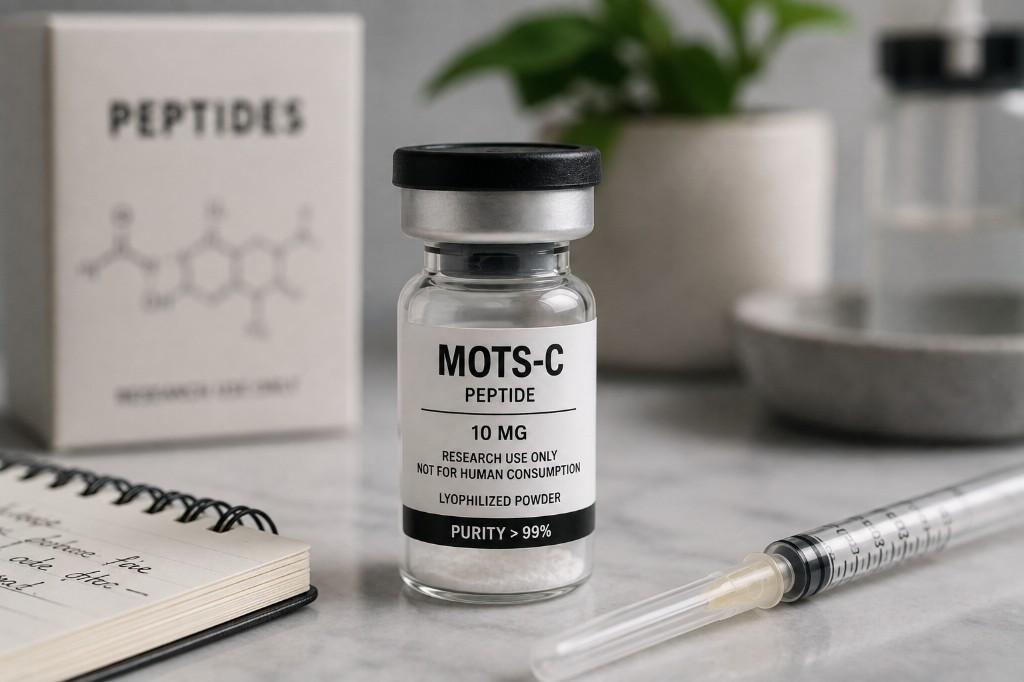
MOTS-c is a 16-amino-acid peptide encoded within mitochondrial DNA. Researchers are studying it for its role in cellular energy signaling, glucose metabolism, metabolic stress, and exercise-related adaptation. But despite growing interest in MOTS-c for weight management, energy, performance, and healthy aging, it is not FDA-approved for any medical indication, and its long-term safety and effectiveness in people have not been established.
MOTS-c has become increasingly visible in longevity, biohacking, weight-management, and performance communities. Online, it is sometimes described as an “exercise mimetic” or mitochondrial peptide that can help with fat loss, endurance, insulin sensitivity, or healthy aging.
The science is more nuanced.
Much of the excitement around MOTS-c comes from laboratory and animal research. Human research is now beginning to move forward—including a Phase 2a trial launched in 2026—but we do not yet have the kind of completed controlled trials needed to establish routine clinical effectiveness, long-term safety, or standard dosing.
At Drip Lounge, we believe emerging peptide science should be discussed with the same standard applied to any other medical or wellness intervention: understand the evidence, understand what remains unknown, and avoid confusing promising research with proven care.
If you are new to the category, start with our beginner’s guide to peptide therapy before exploring individual compounds.
Written by: Drip Lounge Editorial Team
Medically reviewed by: Megan Nickerson, DNP · Last medically reviewed: August 2026
U.S. regulatory status checked: August 11, 2026
Medical disclaimer: This article is for educational purposes only. It does not provide a diagnosis, prescription, dosing protocol, or recommendation to use MOTS-c. Anyone concerned about weight, metabolism, fatigue, recovery, or performance should discuss appropriate options with a qualified healthcare professional.
MOTS-c at a Glance
| Question | Short Answer |
|---|---|
| What is MOTS-c? | A 16-amino-acid mitochondrial-derived peptide |
| Where does it come from? | It is encoded within mitochondrial DNA |
| What is it being researched for? | Metabolic signaling, insulin sensitivity, obesity, exercise adaptation, mitochondrial biology, and aging |
| Is MOTS-c FDA-approved? | No |
| Is MOTS-c proven to cause weight loss? | No. Weight-related evidence is primarily preclinical, and human efficacy has not been established |
| Is it proven to improve athletic performance? | No. Performance findings largely come from animal and mechanistic research |
| Is MOTS-c prohibited in tested sport? | Yes. It is prohibited at all times under anti-doping rules |
| Are “research use only” products proven safe for people? | No. That label does not demonstrate purity, sterility, clinical appropriateness, or regulatory authorization |
The key distinction is simple: MOTS-c is a scientifically interesting mitochondrial peptide, but scientific interest is not the same as an established treatment.
For additional background on the peptide itself, you can also review Drip Lounge’s MOTS-c peptide information page.
What Does MOTS-c Stand For?
MOTS-c stands for Mitochondrial Open Reading Frame of the 12S rRNA type-c.
Unlike most peptides discussed in medicine, which are encoded by nuclear DNA, MOTS-c originates from a short open reading frame within mitochondrial DNA. Researchers first described it as a 16-amino-acid mitochondrial-derived peptide involved in metabolic homeostasis and insulin sensitivity.
Mitochondria are central to cellular energy metabolism, but calling MOTS-c a “mitochondrial peptide” should not be interpreted to mean that administering it has been proven to increase human energy, reverse mitochondrial aging, or improve longevity.
Its origin explains why scientists are interested in it. It does not prove a therapeutic outcome.
This distinction matters because many online MOTS-c pages move directly from mechanism to benefit: mitochondrial peptide → metabolic pathway → therefore better energy or fat loss. That leap is larger than the current human evidence supports.
Why Are Scientists Studying MOTS-c?
MOTS-c attracted scientific attention because mitochondrial biology is closely connected with energy metabolism, stress adaptation, glucose regulation, skeletal muscle function, and aging.
Research has identified several potentially important pathways, but most of this work remains mechanistic or preclinical.
Metabolic Signaling and Glucose Handling
The original 2015 research identified skeletal muscle as an important target and found that MOTS-c influenced metabolic homeostasis and insulin sensitivity in mice. In those experiments, administration of MOTS-c reduced diet-induced obesity and insulin resistance.
That finding generated considerable interest around MOTS-c for metabolism and weight management. But mouse studies cannot tell us whether administering MOTS-c will safely produce the same effect in people.
That question is now being investigated more directly. A Phase 2a randomized, double-blind, placebo-controlled study registered in 2026 is evaluating investigational MOTS-c in 120 adults with prediabetes and overweight or obesity. The study is examining insulin sensitivity, glucose markers, lipids, body weight, waist circumference, and safety over a 12-week treatment period. Results are not yet available, and primary completion is currently estimated for 2027.
That makes MOTS-c a research-stage metabolic candidate, not an established weight-management medication.
Readers focused specifically on weight-management peptides can compare the broader landscape in our guide to peptide therapy and weight-loss goals.
AMPK and the “Exercise Mimetic” Label
One of the most commonly repeated descriptions of MOTS-c is “exercise mimetic.”
The term comes from research showing that MOTS-c interacts with metabolic pathways also activated during exercise, particularly AMP-activated protein kinase, or AMPK. AMPK acts as an important cellular energy sensor and helps coordinate responses to metabolic stress. Research has also shown that MOTS-c can move into the cell nucleus under metabolic stress and influence stress-response gene expression through AMPK-dependent pathways.
A 2021 Nature Communications study found that exercise increased endogenous MOTS-c in humans and that experimentally administered MOTS-c improved physical performance and muscle homeostasis in mice of different ages.
That is interesting biology. It does not mean MOTS-c replaces exercise or has been proven to reproduce exercise’s cardiovascular, musculoskeletal, neurological, or metabolic benefits in humans.
For athletes interested in the broader peptide-recovery conversation, see why athletes are exploring peptide therapy for recovery.
Mitochondrial Resilience and Aging Research
MOTS-c is also being studied because mitochondria play an important role in metabolic adaptation and age-related cellular changes.
Reviews have discussed potential relationships between MOTS-c and metabolic stress, inflammation, age-related disease processes, and mitochondrial signaling. Researchers have also observed associations between endogenous MOTS-c levels and health markers in human populations.
But observational associations are not equivalent to treatment evidence. Finding that naturally occurring MOTS-c levels correlate with a health outcome does not tell us that injecting synthetic MOTS-c will improve that outcome.
What Does the Research Actually Show?
This is where understanding the evidence ladder becomes important.
| Evidence Type | What It Can Tell Us | What It Cannot Tell Us |
|---|---|---|
| Cell/laboratory research | How MOTS-c may interact with pathways such as AMPK and cellular stress signaling | Whether MOTS-c is safe or effective as a treatment in people |
| Animal studies | Potential effects on metabolism, insulin sensitivity, muscle function, or physical performance | Whether humans will experience the same benefits or risks |
| Observational human research | Relationships between naturally occurring MOTS-c and health markers | Whether administering MOTS-c improves those outcomes |
| Early clinical research | Initial safety, pharmacology, or biological signals | Long-term safety or confirmed treatment effectiveness |
| Large randomized clinical trials | Stronger evidence of clinical benefits and risks | Sufficient MOTS-c data of this type are not currently available |
FDA’s 2026 review was particularly cautious. The agency reported that it had not identified publicly available clinical studies or human-exposure data sufficient to evaluate MOTS-c-related bulk substances for the nominated uses. FDA also raised questions about characterization, impurities, aggregation, endotoxin controls, immunogenicity, and the lack of clinical safety information.
A newer Phase 2a human trial is now underway, so the research landscape is evolving—but that study has not yet produced efficacy or long-term safety results.
The appropriate conclusion today is therefore: MOTS-c has scientifically interesting metabolic mechanisms and promising preclinical findings, but it has not yet been established as a safe and effective routine treatment for weight loss, fatigue, performance, or longevity.
Is MOTS-c Approved by the FDA?
No. MOTS-c is not FDA-approved for obesity, weight loss, metabolic disease, fatigue, athletic performance, longevity, osteoporosis, or any other medical indication as of August 11, 2026. FDA’s July 2026 materials state that neither MOTS-c free base nor MOTS-c acetate is a component of an FDA-approved drug.
What Happened With the FDA in July 2026?
The FDA’s Pharmacy Compounding Advisory Committee met on July 23, 2026, to discuss MOTS-c free base and MOTS-c acetate for possible inclusion on the 503A Bulks List, with obesity and osteoporosis among the uses reviewed.
Importantly, the FDA’s own pre-meeting scientific review concluded that the available evidence weighed against placing MOTS-c on the 503A Bulks List. FDA cited limited characterization, absence of adequate clinical effectiveness evidence, insufficient clinical and nonclinical safety information, and unknown immunogenicity risks.
The advisory committee subsequently reportedly recommended inclusion, but an advisory committee recommendation is nonbinding. FDA explicitly states that its advisory committees provide advice and that the agency is not legally required to follow their recommendations. A committee recommendation also does not make MOTS-c an FDA-approved drug.
So headlines suggesting MOTS-c has been “FDA approved” because of the July meeting are incorrect. 503A Bulks List consideration is not the same process as FDA drug approval.
Because this regulatory position is evolving, this section should be reviewed regularly before publication updates.
What Does “Research Use Only” Mean for MOTS-c?
People searching MOTS-c online often encounter injectable-looking vials labeled “research use only” or “not for human consumption.”
Those phrases should not be interpreted as marks of pharmaceutical quality. They do not prove identity, purity, sterility, correct concentration, stability, suitability for injection, or appropriate clinical use.
FDA’s 2026 assessment specifically raised concerns around peptide impurities, aggregation, bacterial endotoxin testing, microbial controls, and product characterization for injectable MOTS-c preparations.
If you want a broader explanation of why sourcing matters across peptide products, read Is Peptide Therapy Safe? Sourcing, Purity, and Medical Supervision.
We also explore similar gray-market issues in The War on the Gray Market: GHK-Cu Edition.
Is MOTS-c Allowed for Athletes?
No. MOTS-c is prohibited at all times for athletes subject to World Anti-Doping Agency rules.
USADA identifies MOTS-c under WADA’s S4.4 metabolic modulators category as an AMPK activator. The restriction applies both in and out of competition.
That is particularly important because MOTS-c is frequently promoted online using exercise, endurance, body-composition, or athletic-recovery language.