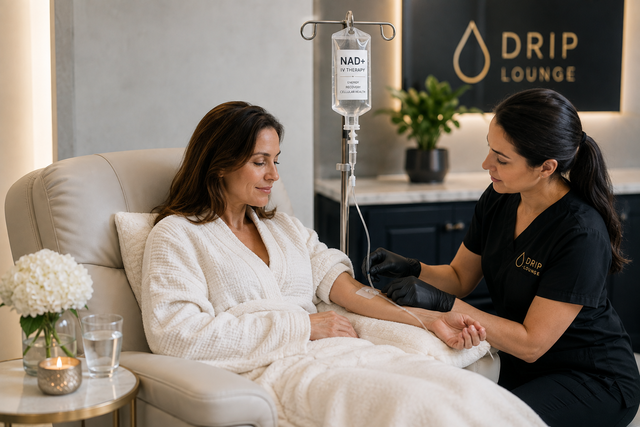
NAD+ IV delivers nicotinamide adenine dinucleotide directly into the bloodstream, while Niagen IV delivers nicotinamide riboside, or NR—a precursor the body can convert into NAD+. Both are used in wellness settings for cellular-energy support, but Niagen IV may be infused faster and with fewer acute infusion sensations. Evidence for long-term clinical benefits remains limited.
People exploring energy, recovery, focus, and longevity support often encounter two similar-sounding options: NAD+ IV therapy and Niagen IV therapy. Because both are connected to the body’s NAD+ pathways, it is easy to assume they are essentially the same treatment.
They are not.
The difference is not simply branding. NAD+ and nicotinamide riboside enter the NAD pathway differently, may create different infusion experiences, and require different considerations around pacing, dose, cost, and treatment goals.
At Drip Lounge, clients can explore both a traditional NAD+ IV therapy option and the advanced Niagen Plus Drip. This guide explains what each infusion contains, how the mechanisms differ, what current research has—and has not—established, and how a provider helps determine which option better fits your goals.
Written by: Drip Lounge Editorial Team
Medically reviewed by: Megan Nickerson, DNP · Last medically reviewed: August 2026
Medical disclaimer: This article is for educational purposes and does not replace medical advice, diagnosis, or treatment. IV eligibility, formulation, dose, and infusion rate should be determined by a licensed healthcare provider.
Niagen IV vs. NAD+ IV at a Glance
| Feature | NAD+ IV Therapy | Niagen IV Therapy |
|---|---|---|
| Core ingredient | Nicotinamide adenine dinucleotide | Nicotinamide riboside, commonly called NR |
| Pathway | Places NAD+ into circulation; extracellular NAD+ may then be metabolized into smaller precursors | Supplies a precursor that cells can use to produce NAD+ |
| Common wellness goals | Energy, focus, recovery, high-demand schedules, healthy-aging support | Cellular energy, mitochondrial support, recovery, focus, and longevity-oriented wellness |
| Infusion experience | May cause nausea, abdominal discomfort, chest pressure, warmth, or other sensations when infused too quickly | Preliminary studies report milder, shorter-lived infusion sensations |
| Infusion time | Often requires slower pacing based on dose and tolerance | May be delivered more quickly, depending on protocol |
| Evidence level | Limited human IV research | Limited but growing human IV research |
| Drip Lounge starting price | From $545 | From $800 |
| Best next step | Provider review based on goals, history, and tolerance | Provider review based on goals, history, and tolerance |
A 2026 retrospective pilot study compared four consecutive 500 mg infusions of NAD+ and NR in a commercial wellness setting. Average infusion time was approximately 97 minutes for NAD+ and 37 minutes for NR. The NAD+ group reported more moderate-to-severe gastrointestinal and chest-related sensations, while the NR group reported milder tingling and cramping. The authors emphasized that the study was small, retrospective, commercially funded, and not designed to establish long-term effectiveness.
What Is NAD+ and Why Does It Matter?
NAD+ stands for nicotinamide adenine dinucleotide. It is a coenzyme involved in essential cellular processes, including mitochondrial energy production, redox reactions, DNA-repair signaling, gene regulation, metabolism, and immune function. NAD+ also serves as a substrate for enzymes such as sirtuins and PARPs.
NAD+ exists in every living cell, but its availability and regulation can change with age and cellular stress. This has driven significant interest in approaches intended to support the NAD metabolome, including oral precursors, injections, patches, and IV infusions. However, raising a biomarker does not automatically prove improvements in fatigue, cognition, athletic performance, or longevity. Reviews of human NAD-boosting studies consistently note that clinical outcomes remain mixed and protocols are not yet standardized.
For a broader introduction, read our guide to what NAD IV therapy is and how it works.
What Is NAD+ IV Therapy?
NAD+ IV therapy administers NAD+ through an intravenous line. This creates direct exposure in the bloodstream, but the cellular mechanism is more complicated than saying intact NAD+ simply enters every cell.
Research suggests that extracellular NAD+ can be broken down into molecules such as nicotinamide mononucleotide, nicotinamide riboside, and nicotinamide before those components are transported into cells and recycled through NAD-producing pathways.
A small 2019 human pilot study found that intravenous NAD+ altered plasma and urinary NAD metabolites during a six-hour infusion. The study helped establish basic pharmacokinetic observations, but it was not a large randomized trial proving outcomes such as improved energy, cognition, or anti-aging effects.
Why Do Clients Explore NAD+ IV?
People commonly explore NAD+ IV in wellness settings for goals involving:
- physical or mental fatigue;
- demanding work and travel schedules;
- recovery support;
- focus and mental clarity;
- cellular-energy support;
- and healthy-aging routines.
These are wellness goals rather than guaranteed clinical outcomes. If you are considering the treatment, our article on the reported benefits and current limits of NAD therapy provides additional context.
How Does NAD+ IV Feel?
The infusion experience varies considerably. Some clients tolerate NAD+ well, while others report discomfort if it is delivered too quickly.
In the 2026 comparative pilot study, reported NAD+ infusion symptoms included abdominal cramping, nausea, vomiting, increased heart rate, throat discomfort, congestion, and chest pressure. The symptoms resolved when the infusions ended, and discomfort led participants to reduce the infusion rate. These results should not be assumed to occur in every patient, but they demonstrate why clinician-guided pacing matters.
The amount infused also matters. Drip Lounge currently offers NAD+ bags at 250 mg, 500 mg, and 750 mg, with pricing beginning at $545. Dose and pacing are selected through a provider-guided process rather than a universal protocol.
For a first-person editorial perspective, see Finding My Energy Again: A NAD Drip Experience. Personal experience should not be treated as clinical evidence, but it can help readers understand what an appointment may feel like.
What Is Niagen IV Therapy?
Niagen is a branded form of nicotinamide riboside, or NR. Nicotinamide riboside is a vitamin B3-related NAD+ precursor, meaning the body can convert it through salvage pathways into NAD+. Unlike direct NAD+ infusion, NR is a smaller molecule that can be transported into cells and used internally to rebuild the NAD pool.
Most established human research on nicotinamide riboside has examined oral supplementation rather than IV administration. Oral studies have generally shown that NR can raise blood NAD-related metabolites and is tolerated at studied doses, but demonstrated health outcomes have varied across populations and endpoints.
Human IV evidence is newer. The 2026 pilot comparison provides preliminary data suggesting that NR IV may be infused more rapidly and produce milder acute sensations than NAD+ IV, but larger randomized trials are still needed.
The Niagen Plus Drip at Drip Lounge
Drip Lounge’s Niagen Plus Drip, also called the Mitochondria Formula, is built around intravenous nicotinamide riboside. It is positioned for clients exploring cellular-energy, recovery, focus, mitochondrial, and longevity-oriented wellness goals.
The service currently offers:
- 250 mg for $800;
- 500 mg for $1,250;
- provider-guided clinical review;
- and an expected infusion window of approximately 30–60 minutes, depending on dose, dilution, and individual tolerance.
Readers evaluating this option may also find our Niagen Plus Drip review and treatment overview useful.
Niagen IV vs. NAD+ IV: Mechanisms and Bioavailability
Direct NAD+ vs. an NAD+ Precursor
The simplest distinction is:
- NAD+ IV introduces NAD+ into circulation.
- Niagen IV supplies NR, which the body uses as a precursor to synthesize NAD+.
However, “direct” does not automatically mean better. Extracellular NAD+ is metabolized before or during cellular uptake, while NR has established transporter and salvage pathways that allow it to enter cells and contribute to NAD synthesis.
This is why Niagen is often described as a precursor-based approach rather than a direct NAD+ replacement.
Which Has Better Bioavailability?
There is not yet enough high-quality human evidence to declare one universally superior.
Preliminary IV studies suggest NR may produce a more comfortable infusion and may increase measured NAD-related biomarkers. But studies remain small, route-specific protocols vary, and standardized tests for NAD status are still developing. The 2026 study itself could not reliably assess changes in whole-blood NAD because of sampling limitations.
The scientifically responsible conclusion is that the two approaches use different delivery pathways, but long-term comparative effectiveness has not been established.
What Does This Mean in Practice?
A provider may discuss NAD+ IV with someone who:
- wants a traditional NAD infusion;
- is comfortable with slower pacing;
- has previously tolerated NAD+;
- or prefers flexible bag sizes and an established clinic protocol.
Niagen IV may appeal to someone who:
- did not enjoy the sensations associated with NAD+;
- values a shorter appointment;
- prefers a precursor-based pathway;
- or is specifically interested in mitochondrial and cellular-energy support.
Neither selection should be based only on trend, price, or online claims.
How They Feel: Client Experience and Side Effects
NAD+ IV Experience
The most important factor in NAD+ tolerability is often the infusion rate. Faster delivery may increase discomfort, while slowing or pausing the drip may make the experience more manageable.
Potential infusion-related sensations reported in early research include:
- nausea;
- abdominal cramping;
- throat or chest discomfort;
- warmth or flushing;
- headache;
- increased heart rate;
- and fatigue.
A licensed clinician should monitor how the client responds and adjust the rate when needed.
Niagen IV Experience
In the recent pilot comparison, NR participants reported milder symptoms such as temporary tongue, jaw, or arm tingling and minor cramping. Average infusion times were shorter than in the NAD+ group. All reported infusion symptoms resolved by completion, and the researchers found no clinically significant changes in the liver, renal, thyroid, or inflammation markers examined over the short follow-up period.
That is encouraging preliminary evidence, but it does not prove that NR IV is risk-free or suitable for everyone.