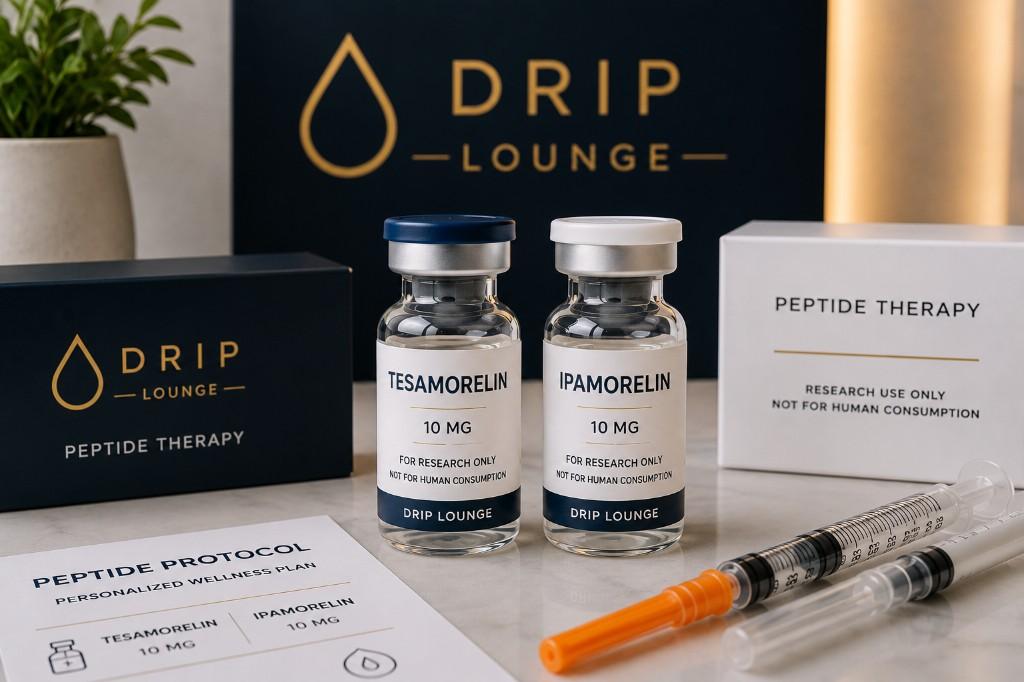
The most evidence-backed “weight loss peptide” options in 2026 are GLP-1 medications like semaglutide and tirzepatide for appetite-driven weight loss, and Tesamorelin for targeted visceral fat reduction in a specific FDA-approved use case. Ipamorelin may support body-composition goals indirectly through growth hormone signaling, but it has less direct weight-loss evidence than GLP-1s or Tesamorelin.
At Drip Lounge, peptide therapy is approached as a provider-guided wellness program, not a quick-fix injection. This guide compares the most talked-about peptides for fat loss, including Tesamorelin, Ipamorelin, CJC-1295, AOD-9604, and GLP-1 medications, so you can understand what actually has evidence, what is still emerging, and what to discuss with a qualified provider.
Disclaimer: This article is educational only and is not medical advice.
Key Takeaways
- GLP-1 medications have the strongest weight-loss evidence for overall body-weight reduction. In a large trial, semaglutide 2.4 mg led to about 14.9% mean body-weight loss at 68 weeks versus 2.4% with placebo.
- Tirzepatide produced even larger average weight loss in major obesity trials, with mean reductions up to about 20%+ over 72 weeks depending on dose and analysis.
- Tesamorelin is not a general weight-loss drug, but it is FDA-approved to reduce excess abdominal fat in adults with HIV-associated lipodystrophy.
- Ipamorelin may support fat-loss programs indirectly by stimulating growth hormone release, but it should not be marketed as a stand-alone weight-loss solution.
- The best peptide protocol depends on the goal: appetite control, visceral fat reduction, muscle preservation, metabolic support, or body recomposition.
Quick Comparison: Best Peptides for Fat Loss in 2026
| Peptide / Medication | Main Mechanism | Best For | Typical Timeline | Evidence Strength |
|---|---|---|---|---|
| Tesamorelin | Growth hormone-releasing hormone analog | Visceral abdominal fat support | 3–6+ months | Strong for HIV-associated visceral fat reduction |
| Ipamorelin | Growth hormone secretagogue | Body composition, recovery, muscle preservation support | 8–12+ weeks | Emerging / indirect |
| Tesamorelin + Ipamorelin | GH-axis support from two pathways | Body recomposition-focused protocols | 3–6 months | Provider-guided / individualized |
| Semaglutide | GLP-1 receptor agonist | Appetite control, significant weight loss | 3–12+ months | Strong |
| Tirzepatide | GIP + GLP-1 receptor agonist | Significant weight loss and metabolic support | 3–12+ months | Strong |
| CJC-1295 | Growth hormone-releasing hormone analog | GH-axis support, body composition | 8–12+ weeks | Limited for direct weight loss |
| AOD-9604 | HGH fragment studied for fat metabolism | Fat metabolism interest | Variable | Limited / mixed |
What Are Weight Loss Peptides and How Do They Work?
A peptide is a short chain of amino acids that can act as a signaling molecule in the body. In wellness and metabolic medicine, the phrase weight loss peptide is often used broadly, but not all peptides work the same way.
Some affect appetite. Some influence growth hormone signaling. Some are discussed for fat metabolism, insulin sensitivity, or body composition. That is why it is important to separate true obesity medications from body-composition peptides.
GH Secretagogues vs. GLP-1 Receptor Agonists
Two major categories dominate the conversation:
Growth hormone-related peptides
These include Tesamorelin, Ipamorelin, and CJC-1295. They work through the growth hormone axis and are usually discussed for visceral fat, lean mass preservation, recovery, and body composition. At Drip Lounge, that conversation often includes options like The Core Leaner (Tesamorelin / Ipamorelin) and Sermorelin under provider guidance.
GLP-1 medications
These include semaglutide and tirzepatide. They work mainly through appetite, satiety, gastric emptying, and metabolic signaling. These have the strongest clinical evidence for meaningful body-weight reduction. Related options on our peptide wellness menu also include Retatrutide for selected metabolic goals.
Read more: Tanning Peptide vs Sun Tanning vs Self-Tanner: Which Lasts Longest?
Tesamorelin for Weight Loss
What Is Tesamorelin?
Tesamorelin is a synthetic growth hormone-releasing hormone analog. It stimulates the pituitary gland to release growth hormone, which may influence fat metabolism and body composition.
The FDA-approved tesamorelin product, EGRIFTA SV, is indicated for reducing excess abdominal fat in adults with HIV-associated lipodystrophy. It is not FDA-approved as a general obesity or cosmetic weight-loss drug.
How Tesamorelin Targets Visceral Fat
Tesamorelin is most interesting because of its effect on visceral adipose tissue, the deeper abdominal fat stored around internal organs.
That makes it different from general appetite suppressants. Tesamorelin is not primarily about making you feel full. It is more about signaling pathways related to growth hormone and abdominal fat metabolism.
Clinical research in people with HIV-associated abdominal fat accumulation found that tesamorelin decreased visceral adipose tissue by about 15% to 20% over 6 to 12 months.
Expected Results and Timeline
For body-composition programs, Tesamorelin is usually not positioned as a “fast weight-loss” option. It is better understood as a visceral fat and metabolic body-composition peptide.
A realistic timeline may look like:
- First 4–8 weeks: early changes in energy, sleep, recovery, or body composition may be noticed by some clients
- 8–12 weeks: more meaningful body-composition changes may begin to appear
- 3–6 months: better window for evaluating abdominal-fat and body-composition response
- 6+ months: longer protocols may be considered depending on provider guidance
Actual results vary based on body composition, nutrition, exercise, sleep, hormones, metabolic health, and consistency.
Who May Consider Tesamorelin?
Tesamorelin may be discussed with a provider for people focused on:
- abdominal fat and waist changes
- visceral fat support
- metabolic wellness
- body recomposition
- alternatives or complements to appetite-focused programs
- GH-axis support under medical supervision
It is not appropriate for everyone. A provider should review medical history, labs, contraindications, medication use, and goals.
Read more: Where to Buy Wolverine Stack Peptides: What to Know Before Choosing a Provider
Ipamorelin for Weight Loss
What Is Ipamorelin?
Ipamorelin is a growth hormone secretagogue. That means it stimulates the release of growth hormone from the pituitary gland.
Unlike some older GH secretagogues, Ipamorelin is often discussed as more selective. Early research described Ipamorelin as a selective growth hormone secretagogue and noted that it did not significantly raise ACTH or cortisol compared with GHRH stimulation.
How Ipamorelin May Support Fat Loss
Ipamorelin is not best understood as a direct fat-loss drug. Instead, it may support a broader body-composition plan by influencing:
- growth hormone signaling
- recovery
- lean mass preservation
- sleep quality in some protocols
- exercise response
- metabolic wellness
Because lean mass is important during weight loss, peptides that support recovery and body composition may be useful in selected patients. But it is important not to overstate the evidence.
Ipamorelin Weight Loss Results: What to Expect
People searching for ipamorelin weight loss results often expect dramatic fat-loss outcomes. A more responsible expectation is that Ipamorelin may support the conditions that make body recomposition easier, especially when paired with nutrition, resistance training, sleep, and medical oversight.
A realistic timeline:
- 4–8 weeks: early subjective changes may appear
- 8–12 weeks: body-composition changes may become more noticeable
- 3–6 months: better window to evaluate progress
Ipamorelin should not be marketed as a substitute for semaglutide, tirzepatide, or clinically indicated obesity treatment.
Read more: KPV Peptide: Anti-Inflammatory Benefits Explained
Tesamorelin vs. Ipamorelin: What Is the Difference?
Tesamorelin and Ipamorelin both interact with the growth hormone axis, but they are not the same.
| Feature | Tesamorelin | Ipamorelin |
|---|---|---|
| Category | GHRH analog | GH secretagogue |
| Main use case | Visceral fat / abdominal fat support | GH release, recovery, body composition |
| Evidence | Stronger for visceral fat in HIV lipodystrophy | More indirect for weight loss |
| Best for | Abdominal fat-focused protocols | Recovery + body recomposition support |
| FDA status | FDA-approved for HIV-associated lipodystrophy | Not FDA-approved for weight loss |
| Weight-loss role | Targeted fat-reduction support | Indirect body-composition support |
The simplest way to explain it:
Tesamorelin is the stronger abdominal-fat peptide.
Ipamorelin is more of a recovery and body-composition support peptide.
Tesamorelin + Ipamorelin Combo: Why Stack Them?
Some provider-guided peptide programs combine Tesamorelin and Ipamorelin because they may support the GH axis through complementary pathways. At Drip Lounge, that combination is offered as The Core Leaner.
The goal of a Tesamorelin + Ipamorelin protocol is usually not just scale weight. It is often focused on:
- abdominal fat support
- body recomposition
- lean mass preservation
- recovery
- sleep and performance support
- metabolic wellness
This type of protocol may be appealing to people who are not only trying to lose weight, but also want to improve how their body looks, feels, and performs.
Who May Be a Good Candidate?
A provider may consider this type of program for someone who:
- struggles with abdominal fat
- wants body-composition support
- is physically active or starting strength training
- wants to preserve muscle while losing fat
- prefers a provider-guided peptide plan
- may not be a fit for GLP-1 therapy or wants a different mechanism
Who May Not Be a Good Candidate?
This may not be appropriate for people who:
- need significant appetite control as the main issue
- have contraindications to GH-axis stimulation
- have uncontrolled medical conditions
- are pregnant or breastfeeding
- expect rapid weight loss without lifestyle changes
- are looking for unregulated online peptides
The best next step is a medical consultation.
Read more: The Wolverine Stack for Athletes: Recovery, Muscle Repair, and Training Longevity