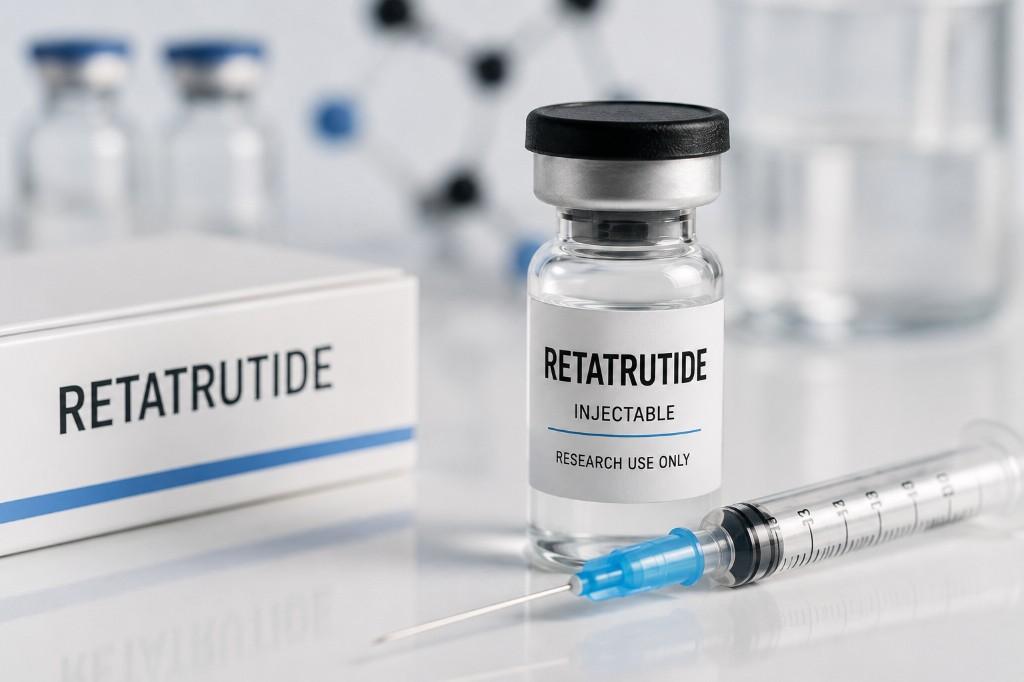
Retatrutide, also known as LY3437943, is an investigational once-weekly injectable medication developed by Eli Lilly that activates three hormone receptors: GLP-1, GIP, and glucagon. Clinical trials have reported substantial average weight reduction, but Retatrutide is still not FDA-approved, cannot legally be compounded under federal law, and has no approved U.S. prescription pathway outside authorized clinical research.
Interest in Retatrutide has grown quickly because early and late-stage clinical research has produced notable weight and metabolic outcomes. The Phase 2 obesity trial reported mean body-weight reductions of up to 24.2% at 48 weeks in the highest-dose study group, and Lilly announced additional positive Phase 3 topline results in July 2026.
But several very different concepts are being blurred together online: promising trial results, FDA approval, legal prescription access, compounding, and “research peptide” sales are not the same thing.
At Drip Lounge, we believe emerging weight-management science should be discussed with accuracy rather than hype. This guide explains what Retatrutide does, why researchers are interested in it, what current trials show, what remains unknown, and what patients can safely discuss with a clinician today.
Written by: Drip Lounge Editorial Team
Medically reviewed by: Megan Nickerson, DNP · Last medically reviewed: August 2026
Last updated: August 11, 2026
Current U.S. status — reviewed August 2026: Retatrutide remains investigational. Lilly has announced plans to submit a U.S. Biologics License Application in the first quarter of 2027. A planned submission is not FDA approval, and there is currently no approved retail prescription pathway for Retatrutide.
Medical disclaimer: This article is educational only and is not medical advice. Retatrutide is not FDA-approved. Do not purchase or self-administer products sold online as Retatrutide.
Retatrutide at a Glance
| Question |
Quick Answer |
| What is Retatrutide? |
An investigational triple hormone receptor agonist |
| Other name |
LY3437943 |
| Developer |
Eli Lilly and Company |
| Receptors targeted |
GLP-1, GIP, and glucagon |
| How is it being studied? |
Once-weekly injection in clinical trials |
| Main areas under study |
Obesity, overweight, type 2 diabetes and related cardiometabolic conditions |
| Is Retatrutide FDA-approved? |
No |
| Can it currently be compounded legally? |
FDA says Retatrutide cannot be used in compounding under federal law |
| Can a doctor prescribe approved Retatrutide today? |
No approved U.S. prescription product currently exists |
| Are approved weight-management alternatives available? |
Yes, depending on clinical eligibility |
FDA specifically states that Retatrutide cannot be used in compounding under federal law, is not a component of an FDA-approved drug, and has not been found safe and effective for any condition.
If you are new to the wider category, our beginner’s guide to peptide therapy explains how peptide-based medications, compounded products, and research peptides differ.
What Does Retatrutide Do?
Retatrutide is described as a triple hormone receptor agonist because it activates three metabolic pathways:
- GLP-1 receptors
- GIP receptors
- Glucagon receptors
That third pathway is what primarily separates Retatrutide from medications such as semaglutide and tirzepatide.
GLP-1 Receptor Activity
GLP-1 stands for glucagon-like peptide-1.
GLP-1 signaling is involved in:
- appetite regulation;
- satiety or feelings of fullness;
- gastric emptying;
- glucose-dependent insulin secretion;
- and post-meal glucose control.
This is the primary receptor targeted by semaglutide products such as Wegovy.
FDA continues to recognize semaglutide as an approved GLP-1 receptor agonist for specific indications, including chronic weight management under appropriate Wegovy labeling.
Retatrutide includes this GLP-1 activity but adds two additional pathways.
GIP Receptor Activity
GIP stands for glucose-dependent insulinotropic polypeptide.
It is another gut-derived hormone involved in post-meal metabolic signaling and insulin response.
Tirzepatide already combines GLP-1 + GIP receptor activity. FDA-approved Zepbound, whose active ingredient is tirzepatide, is approved for chronic weight management in eligible adults and works through these two receptor pathways.
Retatrutide adds a third component: glucagon receptor activity.
Glucagon Receptor Activity
Glucagon traditionally has a reputation as a hormone involved in raising blood glucose, but glucagon signaling also affects energy metabolism.
Researchers are studying whether carefully balanced glucagon receptor activation, alongside GLP-1 and GIP activity, may contribute to:
- energy expenditure;
- lipid metabolism;
- liver metabolism;
- and overall body-weight regulation.
This additional pathway is why Retatrutide is sometimes described as a next-generation triple agonist.
A simple way to understand the difference is:
Semaglutide targets GLP-1. Tirzepatide targets GLP-1 and GIP. Retatrutide is being studied because it combines GLP-1, GIP, and glucagon receptor activity.
That scientific distinction does not mean Retatrutide is automatically better for an individual patient.
Why Is Retatrutide Getting So Much Attention?
The attention is understandable.
Retatrutide represents the next stage of incretin and metabolic medicine research, and clinical-trial results have been substantial.
The problem is that social media often turns “promising clinical trial” into “best weight-loss drug available now.”
Those are very different claims.
What Phase 2 Research Found
The published Phase 2 obesity trial included 338 adults with obesity and evaluated multiple once-weekly Retatrutide doses over 48 weeks.
At week 48, mean body-weight change was:
- −8.7% in the 1 mg group;
- −17.1% in the combined 4 mg group;
- −22.8% in the combined 8 mg group;
- −24.2% in the 12 mg group;
- compared with −2.1% with placebo.
These are impressive trial averages.
They are not a promise that an individual will lose 24.2% of their body weight, nor do they justify purchasing an unapproved Retatrutide product online.
Study populations, medical screening, formulation, dose escalation, monitoring, and follow-up all matter.
What Phase 3 Research Is Showing
Retatrutide has moved into an extensive Phase 3 program.
In July 2026, Lilly announced positive topline results from two additional Phase 3 trials.
In TRIUMPH-2, involving adults with overweight or obesity and type 2 diabetes, the highest studied Retatrutide dose produced an average weight reduction of 20.8% at 80 weeks.
In TRIUMPH-3, involving adults with severe obesity and established cardiovascular disease, Lilly reported mean weight loss of up to 22.6% at 80 weeks.
Those results are company-reported topline Phase 3 findings. They are important, but they should still be distinguished from a complete peer-reviewed dataset and an FDA regulatory decision.
Meanwhile, other Retatrutide studies continue. ClinicalTrials.gov lists active Phase 3 and Phase 3b programs investigating obesity, weight maintenance, dose-escalation approaches, cardiovascular outcomes, and direct comparison with tirzepatide.
Retatrutide Evidence: What Is Known and What Is Still Unknown?
For GEO and medical accuracy, it helps to separate evidence levels.
| Evidence Category |
What We Know |
What Remains Unknown |
| Mechanism research |
Retatrutide activates GLP-1, GIP and glucagon receptors |
How that translates to long-term outcomes for every patient |
| Published Phase 2 trial |
Substantial average weight reduction occurred over 48 weeks |
Long-term maintenance and broader real-world outcomes |
| Phase 3 program |
Lilly has reported positive topline findings from multiple trials |
Full datasets and final regulatory interpretation |
| Safety evidence |
GI effects are common and dose-related in studies |
Complete long-term safety across broader populations |
| Regulatory status |
Lilly plans an FDA application |
Whether, when and for exactly which indications approval will occur |
| Real-world use |
None as an approved Retatrutide product yet |
Long-term effectiveness after widespread clinical use |
The strongest evidence-based conclusion today is:
Retatrutide is a promising investigational medicine with meaningful clinical research behind it. It is not yet an FDA-approved treatment, retail prescription product, or legal compounded alternative.
For broader context on how Drip Lounge evaluates emerging peptide claims, read Is Peptide Therapy Safe? Sourcing, Purity, and Why Medical Supervision Matters.
Is Retatrutide FDA-Approved?
No.
As of August 11, 2026, Retatrutide is not FDA-approved for:
- obesity;
- chronic weight management;
- type 2 diabetes;
- sleep apnea;
- cardiovascular disease;
- osteoarthritis;
- liver disease;
- or any other indication.
FDA goes further than simply calling it unapproved: its current GLP-1 safety guidance says Retatrutide cannot be used in compounding under federal law.
What Does “Investigational” Mean?
An investigational medication is still being studied and evaluated.
Retatrutide:
- is being tested in clinical trials;
- has not completed FDA marketing review;
- does not yet have approved prescribing information;
- does not have an FDA-approved commercial formulation;
- and cannot legally be treated as though it were a currently approved weight-loss medication.
Promising clinical results are one step in drug development.
They are not FDA authorization.
When Could Retatrutide Be Approved?
Lilly stated on July 23, 2026 that it plans to submit a Biologics License Application to FDA in Q1 2027.
That is the clearest current timeline signal.
But: submission ≠ approval.
FDA would still need to review the application, evidence, manufacturing information, safety data, labeling, and proposed indications.
For that reason, predicting a firm retail launch date is premature.
Can You Get Retatrutide Now?
There is currently no legitimate FDA-approved Retatrutide prescription product available to patients in the United States.
Clinical Trials
Authorized clinical research is the legitimate pathway for receiving an investigational medication such as Retatrutide.
ClinicalTrials.gov currently lists numerous Retatrutide trials, including Phase 3 programs studying obesity and related conditions. For example, TRIUMPH-5 is directly comparing Retatrutide with tirzepatide in adults with obesity, with primary completion currently estimated for late 2026.
Enrollment status varies by trial and location, so patients interested in research participation should use official clinical-trial resources rather than commercial peptide sellers.
Why “Buy Retatrutide Online” Is a Major Red Flag
This is one of the most important parts of the article.
If a website is selling “Retatrutide” directly to consumers today, that does not mean it has gained early access to an approved medication.
FDA has specifically warned consumers about Retatrutide products sold online and about companies marketing unapproved Retatrutide.
The agency states that products falsely labeled:
- “research use only”;
- “for research purposes”;
- or “not for human consumption”
have still been marketed to consumers for human use. FDA warns that these products may be of unknown quality and potentially harmful.
FDA has also issued enforcement letters involving sellers of unapproved Retatrutide in 2025 and 2026.
The risks include:
- uncertain identity;
- incorrect concentration;
- contamination;
- inconsistent formulation;
- lack of appropriate refrigeration;
- absence of medical screening;
- inaccurate dosing instructions;
- and no reliable pathway for managing adverse effects.
This is closely related to the broader peptide gray-market issue we discuss in The War on the Gray Market.
What Can You Discuss With a Clinician Today?
The fact that Retatrutide is investigational does not mean patients need to wait for weight-management care.
A provider can currently discuss:
- medical history;
- weight history;
- metabolic health;
- current medications;
- nutrition;
- activity;
- sleep;
- laboratory evaluation when appropriate;
- behavioral support;
- and currently available FDA-approved weight-management medications when clinically appropriate.
You can also explore our broader guide to peptide therapy for weight-management goals.
For people interested specifically in growth-hormone-axis body composition strategies rather than appetite-focused medications, our Tesamorelin + Ipamorelin guide explains that very different mechanism.
Retatrutide vs. Semaglutide vs. Tirzepatide
This comparison is useful because the three medications are often grouped together online, but their status and mechanisms differ substantially.
| Feature |
Semaglutide |
Tirzepatide |
Retatrutide |
| Main pathways |
GLP-1 |
GLP-1 + GIP |
GLP-1 + GIP + glucagon |
| Type |
Single receptor agonist |
Dual receptor agonist |
Triple receptor agonist |
| Approved weight-management product |
Wegovy |
Zepbound |
None |
| FDA status |
FDA-approved for specific indications |
FDA-approved for specific indications |
Investigational |
| Clinical maturity |
Extensive clinical and post-market data |
Extensive clinical and post-market data |
Phase 2 published + Phase 3 program |
| Available by prescription now |
Yes, when appropriate |
Yes, when appropriate |
No approved prescription pathway |
| Can Retatrutide-style online versions substitute? |
N/A |
N/A |
No |
FDA-approved Wegovy is based on semaglutide and acts through GLP-1 signaling, while Zepbound contains tirzepatide and activates GLP-1 and GIP receptors.
Retatrutide adds glucagon receptor activity.
That makes Retatrutide scientifically different.
It does not yet make it clinically superior.
Does Retatrutide Cause More Weight Loss Than Tirzepatide?
This is one of the most tempting comparisons to make and one of the easiest to oversimplify.
The Phase 2 Retatrutide trial reported average reductions up to 24.2% at 48 weeks.
FDA’s original Zepbound approval described an average body-weight reduction of about 18% at 72 weeks with the highest approved tirzepatide dose in adults without diabetes in a pivotal trial.
But placing those numbers side by side and declaring Retatrutide “better” is not scientifically sound.
The trials differed in:
- study populations;
- duration;
- protocols;
- doses;
- inclusion criteria;
- statistical methods;
- and treatment settings.
The strongest answer will come from direct head-to-head trials. Lilly’s ongoing TRIUMPH-5 study is specifically comparing Retatrutide with tirzepatide in adults with obesity.
Until those results are complete, “Retatrutide beats tirzepatide” is marketing language—not a settled clinical conclusion.
Retatrutide Side Effects and Safety Considerations
Because Retatrutide is investigational, there is no final FDA-approved prescribing label defining its complete safety profile.
The published Phase 2 obesity trial found that the most common adverse events were gastrointestinal, were generally mild to moderate, and occurred more often at higher doses.
Reported effects included gastrointestinal symptoms typical of incretin-pathway therapies, such as:
- nausea;
- diarrhea;
- vomiting;
- constipation;
- and abdominal or gastrointestinal discomfort.
The study also reported dose-dependent increases in heart rate that peaked around week 24 and later declined.
This does not mean every future Retatrutide patient would experience these effects. It means safety monitoring remains an important part of the research program.
Who Needs Careful Clinical Review?
A clinician assessing any incretin-based weight-management option will typically need to know about factors such as:
- pregnancy or plans to become pregnant;
- breastfeeding;
- significant gastrointestinal disease;
- history of pancreatitis;
- gallbladder problems;
- medications that affect blood glucose;
- serious medication allergies;
- unexplained abdominal symptoms;
- and relevant endocrine history.
Approved medications have their own specific contraindications and warnings. For example, FDA-approved Zepbound has warnings and contraindications that include specific thyroid C-cell tumor considerations, pancreatitis, gallbladder disease, and other risks.
Those approved-label warnings should not simply be copied over to Retatrutide as though the products are interchangeable. Retatrutide’s final safety labeling will depend on its own completed development program and FDA review.
When to Seek Urgent Medical Care
Anyone using a medication or unknown injectable product who experiences severe persistent abdominal pain, repeated vomiting with dehydration, trouble breathing, fainting, severe chest pain, or signs of a serious allergic reaction should seek prompt medical attention.
And if the product was obtained from an unverified online seller, clinicians need to know exactly what was purchased and, if possible, see its packaging.
Who Should Be Careful About Retatrutide Claims Online?
Be skeptical when a website:
- sells Retatrutide directly to consumers;
- advertises “compounded Retatrutide” as though this were currently permitted;
- calls Retatrutide FDA-approved;
- guarantees 20%, 25%, or 30% weight loss;
- advertises “Retatrutide near me” without explaining its investigational status;
- uses before-and-after photos as proof;
- provides self-directed dosing or titration instructions;
- encourages switching from an approved medication without clinician involvement;
- or markets a “research use only” vial as a wellness product.
FDA’s position is unusually clear here: Retatrutide cannot currently be used in compounding under federal law, and the agency urges consumers not to purchase unapproved Retatrutide products sold directly online.
For a deeper explanation of why sourcing, sterility, identity and medical oversight matter with injectable peptides, read Is Peptide Therapy Safe?.
What to Discuss With a New York Weight-Management Provider
A responsible weight-management consultation should start with you, not with a trending drug name.
If you live in Newburgh, the Hudson Valley, Westchester, New York City, Manhattan, the Bronx, or surrounding New York communities, a weight-management provider should be willing to clearly explain:
- what medications are actually available;
- what remains investigational;
- which options fit your health history;
- what laboratory testing may be appropriate;
- what side effects need monitoring;
- how nutrition and activity fit into treatment;
- what realistic outcomes look like;
- and what follow-up will be provided.
The consultation should not begin with: “Which research peptide do you want to buy?”
It should begin with: “What are your health goals, and what is the safest evidence-based way to address them?”
At Drip Lounge, this distinction matters.
You can review our Retatrutide research information page for additional educational context, but Retatrutide should not currently be treated as an available prescription or compounded weight-loss product.
If your goal is weight management today, a provider can instead discuss currently available and clinically appropriate pathways.
Frequently Asked Questions About Retatrutide
Is Retatrutide Approved by the FDA?
No. As of August 2026, Retatrutide remains investigational and is not FDA-approved for obesity, weight loss, diabetes, or any other medical condition. Lilly says it plans to submit a U.S. regulatory application in Q1 2027.
What Is Retatrutide Used For?
Retatrutide is currently being studied, rather than being approved “for” a medical use. Its clinical development program includes obesity, overweight with weight-related conditions, type 2 diabetes, cardiovascular outcomes and other metabolic or obesity-associated conditions.
Is Retatrutide the Same as Tirzepatide?
No. Tirzepatide activates GLP-1 and GIP receptors. Retatrutide activates GLP-1, GIP and glucagon receptors. Tirzepatide has FDA-approved products, including Zepbound for chronic weight management in eligible adults; Retatrutide remains investigational.
Is Retatrutide the Same as Semaglutide?
No. Semaglutide is primarily a GLP-1 receptor agonist. Retatrutide is a triple agonist involving GLP-1, GIP and glucagon receptor signaling. FDA-approved semaglutide weight-management products currently exist; Retatrutide has not been approved.
Can I Buy Retatrutide Online?
Products labeled Retatrutide can be found online, but that does not make them approved or appropriate for human use. FDA warns consumers not to purchase unapproved products sold as Retatrutide and says products labeled “research use only” may be of unknown quality and potentially harmful.
Can Retatrutide Be Compounded?
FDA currently states that Retatrutide cannot be used in compounding under federal law.
When Will Retatrutide Be Available?
There is no confirmed retail availability date. Lilly plans to submit a U.S. application in Q1 2027, but FDA review would still need to occur before any approval or commercial prescription pathway could begin.
How Much Weight Did People Lose in Retatrutide Trials?
In the published 48-week Phase 2 obesity study, average body-weight reduction reached 24.2% in the 12 mg study group, compared with 2.1% with placebo. That is a clinical-trial average, not an expected or guaranteed individual result.
Is Retatrutide Better Than Tirzepatide?
That has not been established. Comparing separate trials can be misleading because study design and populations differ. A Phase 3 head-to-head trial comparing Retatrutide with tirzepatide is underway, with completion expected later in 2026.
The Bottom Line
Retatrutide is one of the most important emerging medications in obesity and metabolic research.
Its triple-receptor mechanism—GLP-1 + GIP + glucagon—distinguishes it from semaglutide and tirzepatide. Published Phase 2 data showed substantial average weight reduction, and Lilly has now announced positive findings from multiple Phase 3 studies.
But the most important fact for patients today is simpler:
Retatrutide is still investigational. It is not FDA-approved, it does not have an approved U.S. prescription pathway, and FDA says it cannot currently be used in compounding under federal law.
That means the right response to Retatrutide’s promising science is not to buy a vial from a research-peptide website.
It is to understand what the research shows, follow the regulatory process, and speak with a qualified provider about safe weight-management options that are actually available today.
At Drip Lounge, our approach is provider-guided and evidence-informed. If your goals involve weight management, metabolic health, body composition, or energy, start with a clinical evaluation rather than an unapproved product.
Interested in weight management or metabolic wellness? Book a provider-guided consultation to discuss evidence-based options that may be appropriate for you.